
Substack Is Not Your Liberator
And Hamish McKenzie isn't your benevolent uncle.

I am about to break two of my own rules for writing this newsletter.
Don’t write about Substack qua Substack, Substack as a platform. While there is a lot of attention to be gained in doing so, this is not what I want to spend my time on here.
Don’t write, primarily, from a place of exasperation and anger.
But there are limits to all rules and over the last couple of days I’ve reached my limit.
(Perhaps some of this ire is also rooted in being heartsick about the federal government murdering another person in Minneapolis and having nothing meaningful beyond expressions of heartsickness, but feeling the urge to express something, anything as a reminder to myself of my own humanity.)
In Substack Notes, Substack co-founder Hamish McKenzie announced the launch of a beta version of Substack TV, an app download available on Apple TV and Google TV.
This is part of a larger don’t-call-it-a-pivot to video that Substack has been pursuing over the last year or so through supporting video podcasts and Substack live chats. McKenzie still regularly proselytizes for the unique virtues of the written word, but Substack TV is clearly designed as a vehicle for the “creators” of the world, not the writers.
Whenever McKenzie announces one of these initiatives, or really says anything at all, there is a class of contributor here the arrives to treat him as some mix of oracle and benevolent uncle who brought you that new action figure you’ve always wanted but didn’t think you’d get. This next sentence is the anger talking, but I find these prostrations embarrassing, even pathetic. I do not understand how in the year 2026 adults can walk around with anything other than suspicion for the owners of these media platforms.
I don’t mean to suggest that we owe Hamish McKenzie our hostility - though this is the path I’ve chosen - but this kind of simpering praise should be beneath anyone’s dignity. You would not do this when Verizon announces a discounted additional line on your account.
Shifting from ire to analysis I’d like to unpack some of McKenzie’s claims about Substack in the wake of this latest announcement. In my chapter “On the Future of Writing for Money” in More Than Words I look in general at the potential for subscription-based aggregator platforms as vehicles for sustainable incomes for writers and declare a decidedly mixed-bag. Yes, there is some money to be earned - for now - but we know that the long term prospects for writers are not positive.
Hamish McKenzie sees things differently, or at least says he does. We’re looking at a revolution:
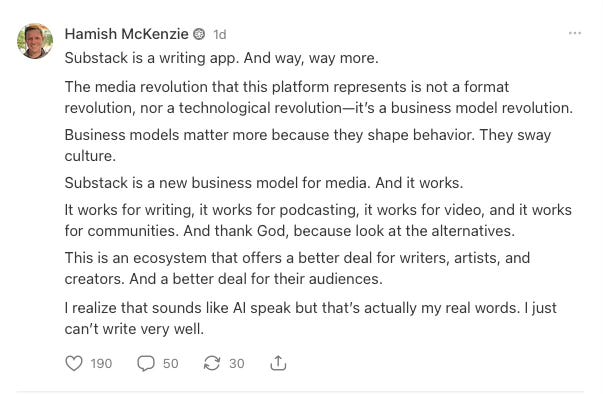
It is impossible to tell if McKenzie believes this or not, if it is a sales pitch for the masses or the kind of self-delusion required of someone in his pursuit, but all of this is total nonsense.
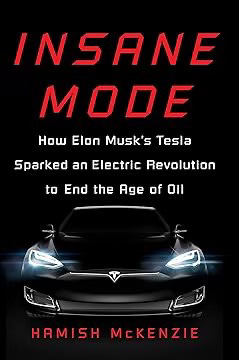
Speaking of nonsense, here’s the book McKenzie published prior to launching Substack when he was an “independent journalist” who just happened to write PR for tech companies.
Anyway. Let’s break down McKenzie’s claims.
“Substack is a writing app. And way, way more.”
True. It’s also a podcast, video, and social media app.
“The media revolution that this platform represents is not a format revolution, nor a technological revolution—it’s a business model revolution.”
Umm…what? At Substack people pay money for access to content. This money is shared between the creators of the content and the distributors of the content. This same cutting edge technology dates back to something known as a “newsstand.”
I know that people like to believe they’re on the inside track of something special, but let’s be frank with ourselves. Substack has done well at establishing a beachhead for users and attention that its predecessors like Medium could not, but there is nothing revolutionary going on here.
“Business models matter more because they shape behavior. They sway culture.”
I have no idea what this might mean, probably because it doesn’t mean anything. What behavior is Substack shaping? How is the culture itself being swayed? This is pitch meeting speak that for some reason some of the participants here lap up. Again, embarrassing.
“Substack is a new business model for media. And it works.
It works for writing, it works for podcasting, it works for video, and it works for communities. And thank God, because look at the alternatives.”
If by “works” he means that the site correctly displays and distributes the content (most of the time), I agree. But I think he means something beyond that. The fact that a small handful of people make a lot of money, some other people make a decent amount of money and the vast majority make very little money is not a revolutionary business model. Chris Anderson’s The Long Tail: Why the Future of Business Is Selling Less of More has its 20th anniversary this year.
Bandcamp, which is Substack for music, and by far the closest analogue, was founded in 2008 and had a long run of being genuinely supportive for independent musical artists - operating without venture capital - until it was sold to Epic and things got a bit squishy.
Substack has been beholden to Marc Andreessen from the outset. Substack wants you to believe that it is infrastructure for writers to do what they wish. It is not.
“This is an ecosystem that offers a better deal for writers, artists, and creators. And a better deal for their audiences.”
Substack being a better deal for the content purveyors of the world is very much dependent on circumstances. A handful of people are pulling down seven-figures. Some people who had very little potential to earn anything might now be getting a few thousand a year for their efforts. Personally, as an old and a professional writer, I preferred the time where you could write for a publication and receive payment or even a salary and extra perks like insurance and vacation. I understand that this old system is gone, but I don’t think McKenzie is simply saying it’s better than bad present alternatives. This is a “revolution” after all.
On the audience side, it definitely is not a better deal. I will not disclose how much I spend annually on paid Substack subscriptions to individual newsletters, but it is a lot and as much as I enjoy and want to support those writers the cost of a single subscription used to buy me weekly access to the revolutionary technology known as the “magazine” where I could read a dozen writers all in one handy package delivered to my door.
Again, this is not a lament about the world gone by, but an attempt to add some perspective to claims of revolution. In reality, Substack is simply a way station on the continuous slide down the hill.
Yes, some people have done very well for themselves as individuals by establishing newsletters here. Heather Cox Richardson, Matt Yglesias, George Saunders, random anti-vax conspiracists, have all found audiences sizable enough to both garner money and attention. Heck, if you can combine your newsletter with the preternatural ability to flatter the sensibilities of the tech oligarch class you may find yourself with a nine-figure payday and as the next chief of CBS News!
But I am imploring people to be sensible about the underlying dynamics. Substack is a tech company that has taken in over $200 million dollars in venture capital investment. It’s is theoretically valued at over a $1 billion. They are not here to empower we sensitive wordsmiths so we can revolutionize culture.
They’re in it for the money. I promise.
Moving into podcasts, video, and now Substack TV is part of a larger phenomenon with platforms trying to lock in users with exclusive content. It’s why YouTube and now Netflix are podcast platforms. Substack is betting/hoping that they have some number of participants here that are desirable enough to draw some people toward that TV app, but straight talk here, unless you are the people I named above or Paul Krugman or Katie Couric or Jim Acosta or The Bulwark or some maniac white supremacist who has managed to gather a critical mass of gutter racists around a burning cross, Substack TV is not for you.
Substack is not a filter for quality expression or uniqueness of insight. It is like every other platform, a gatherer of eyeballs. If AI slop newsletters are translated to AI slop video that enough people watch on Substack TV to sell apps or subscriptions, that’s what Substack will promote.1
Do thirty seconds of research on what it has been like for YouTube creators and you will see the ultimate trajectory of Substack TV except you won’t have a chance to make the kind of money that was available on YouTube for at least a while.
You are not going to become Mr. Beast. Substack TV is not a portal through which people will find your writing. Kissing up to Hamish McKenzie doesn’t make the impossible more likely.
McKenzie had another Notes post that I think is especially clarifying in terms of the delusion he’s trying to perpetrate.
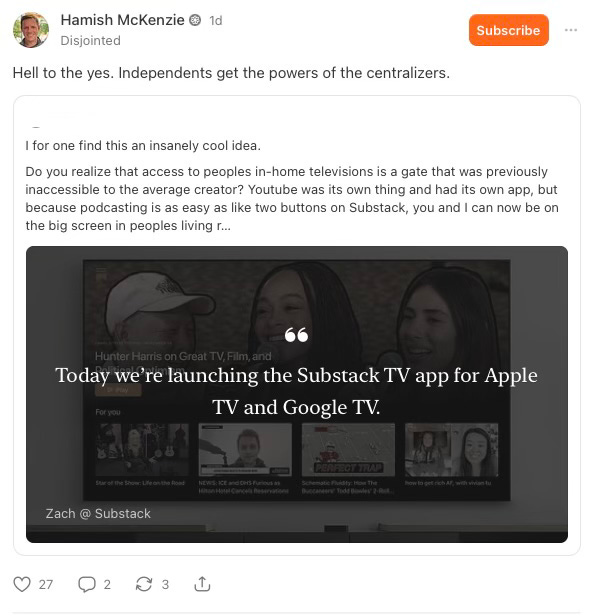
Perhaps unintentionally, McKenzie’s use of “independents” and “centralizers” in this way clarifies the relationship between newsletter writers and the platform. McKenzie wants us to believe - like the original note writer whose handle I’ve redacted - that Substack is our portal to the world, but the reality is that newsletter writers are to Substack as drivers are to Uber.
Substack’s pitch to writers has been that you “own your audience,” in that you have access to subscriber emails and could - in theory - move them to another platform. This is not actually revolutionary by itself - the same is true on MailChimp - and increasingly it is no longer true. Followers are not necessarily subscribers. The “discovery” via the social media platform or the “rising” charts are exclusive to Substack. (And already a reason people who are otherwise desiring to leave, stay.)
For the time being, podcast and video contact can be ported to other platforms, but the inexorable trend is towards exclusivity. Substack doesn’t have the muscle to force these choices on newsletter writers, but when they do, they could, and they will.
This is not a collective or collaborative enterprise. The same way Uber has gradually squeezed margins out of the drivers, Substack will do the same here. The platform’s whales will either be exempted or are large enough to absorb the extra hit. The rest of the us will be told to like it or lump it and for those who are overcommitted to the platform either practically or psychologically, they will have to like it.
My advice is that you have to be prepared to lump it at a moment’s notice because your only hope is that Hamish McKenzie is as benevolent as he comes across on his own platform’s social media interface.
But we know he’s spouting nonsense. We know what the trajectory of these sorts of platforms is based on previous experience. Maybe sucking up to Hamish is a smart play. Maybe my criticism here is the act of an idiot and the owners will flip a switch on the algorithm consigning me to newsletter oblivion without me ever knowing.
The point is that these are their switches. Your train is on someone else’s track and they could take action that will cause you to derail. You won’t even see it coming and nothing can protect you.
So what’s the plan? What’s the alternative?
In More Than Words I argue that the best long term, sustainable bet for writers is to follow the model of entities like Defector and Flaming Hydra and gather together under umbrellas that are actually owned and controlled by the writers themselves. There are not nine-figure paydays in these models, but there is good, interesting, sustaining and sustainable work.
If a person who is smarter and more organized than me got something like this going that was a good fit for my work and could pay me the same amount I make from this newsletter, I would join in an instant. I lament that I don’t have the necessary hustle/drive/time to spearhead something like this.
In the meantime I will continue to write here as long as it makes sense for me to do so. That could be a day - if Hamish takes a dimmer view on me than on the cranks and conspiracists who also populate this platform - or it could be years. I do know that even as my total subscriber base and readership seems to increase, my personal revenue declines slightly year-to-year. (This is an observation about the business dynamics of the platform, not a complaint directed at subscribers of all stripes that I value deeply.)
Others can make their own judgments, but I’m imploring everyone to not be a sucker for Hamish McKenzie’s VC sales pitch. By all means squeeze the Substack lemon of as much juice as possible, but recognize that Substack is not the vehicle for your own liberation. The platform owners do not have your best interests in mind. Quality may matter to some degree, but it is not determinative.
That’s not how these things ever have or ever will work.
Links
This week at the Chicago Tribune I explored my surprising disappointment in George Saunders’ new novel Vigil. Is it me? Is it the book? Or is it maybe some combination of the two?
At Inside Higher Ed I did my thing where I use the impulse by some to outsource their writing to AI in order to examine the underlying dynamics of the thing they’re being asked to write. In this case it’s the personal statement as part of applying to graduate school.
Matt Seybold paid attention to what was going on at Davos and the news is not good when it comes to those of us looking for lives independent of AI.
In other education technology news let me recommend this piece from 13-year-old Micha Blachman reviewing the technology he uses in his day-to-day schooling. Schools should absolutely hire this kid as a consultant, pronto.
Via my friends McSweeney's and by the great John Moe, himself a man of Minnesota, from the laugh to keep from crying category, “I am the Payroll Accountant for Professional Protesters in Minnesota and I am Swamped.”
Recommendations
1. The 13½ Lives of Captain Bluebeard by Walter Moers
2. Entangled Life: How Fungi Make Our Worlds, Change Our Minds and Shape Our Futures by Merlin Sheldrake
3. If You’re Freaking Out Read This: A Coping Workbook for Building Good Habits, Behaviors, and Hope by Simone DeAngelis
4. The Story of a Snail Who Discovered the Importance of Being Slow by Luis Sepulveda
5. All Systems Red by Martha Wells
Ruth S. - State College, PA
It’s exciting to see a list and know instantly that the right recommendation is by a friend of the newsletter, in this case Katherine E. Standefer and her fascinating book, Lightning Flowers: My Journey to Uncovering the Cost of a Life.
I continue to believe that this is going to end, but ending it will require concerted and coordinated efforts like the brave people of Minneapolis taking to the streets to register their refusal to be subject to authoritarian rule. The Trump regime will continue to lie even when evidence to the contrary is incontrovertible. But there is simply too much resistance rooted for the authoritarians to win. I believe that.
If anyone has knowledge of how to best support the work closest to the resistance, I urge you to share it in the comments.
Stay warm, stay safe, stay fierce.
JW
The Biblioracle
I’ve chosen not to do a detailed separate analysis of Substack TV as a business proposition, but suffice to say I think the odds are long that this gets any penetration. Smart TVs, Roku, et al. are already saturated with “channels” providing content no one asked for and almost no one watches. I get why Substack feels like they have to take this swing because it’s the direction platforms are going but it’s almost certainly going to be a miss.
I just read Micha's post and agree that kid IS fantastic- plus McSweeney's. Two good smiles out of a sad start to the day. I also read all of the post, John, and am waiting for you to move to Patreon now with Lyz Lenz. Other John: Thanks for stand with MN link. Already sent some cash to somebody somewhere who is doing something. Feel helpless here (I'm south of Mason Dixon line) but can at least do that much.
https://www.standwithminnesota.com/