
Taste Is Human
And these days, a necessity.

That Story Everyone Is Talking About Is Bad
Some, perhaps many of you have heard of the scandal involving a prize-winning story from a contest sponsored by Granta that is almost certainly AI-generated. I have no wish to litigate the story’s provenance or quality. Others, including Lincoln Michel (here) and Phil Christman (here) have done this more thoroughly and perceptively than I ever could.
The story is bad, with a sheen of surface-level lyricism that is actually nonsense. I know this because I read it, or enough of it anyway, and because I’ve spent a decent portion of the last 35 years reading/writing/reviewing/thinking about narrative fiction.
I saw a couple of posts on social media or here in the Substack notes feature that tried to gin up some enthusiasm for the story’s quality - after all, it won a prize - but that it won a prize is an indicator of a problem with the process/people who judged the prize, not the story’s quality.
The people who awarded this story a prize do not have taste.
Notice, I didn’t say they have bad taste, I mean they don’t have any taste, meaning the internal capacity to respond to the what the text is trying to achieve and render a judgment from that response. Another possibility is that they subsumed their taste to what they thought might be the taste of others, choosing what they think a prize-winning story looks like on the surface, rather than what it actually is, which is bad.
Taste Is in the Air
Apparently discussions of taste are all the rage in Silicon Valley. Kyle Chayka of the New Yorker and author of Filterworld: How Algorithms Flatten Culture wrote back in March “Why Tech Bros Are Obsessed With Taste” and more recently was part of a New York Times podcast that asked, “Which Has Better Taste: AI or Humans?” an unserious question and something only a tech bro would think to ask because they don’t seem to understand taste.
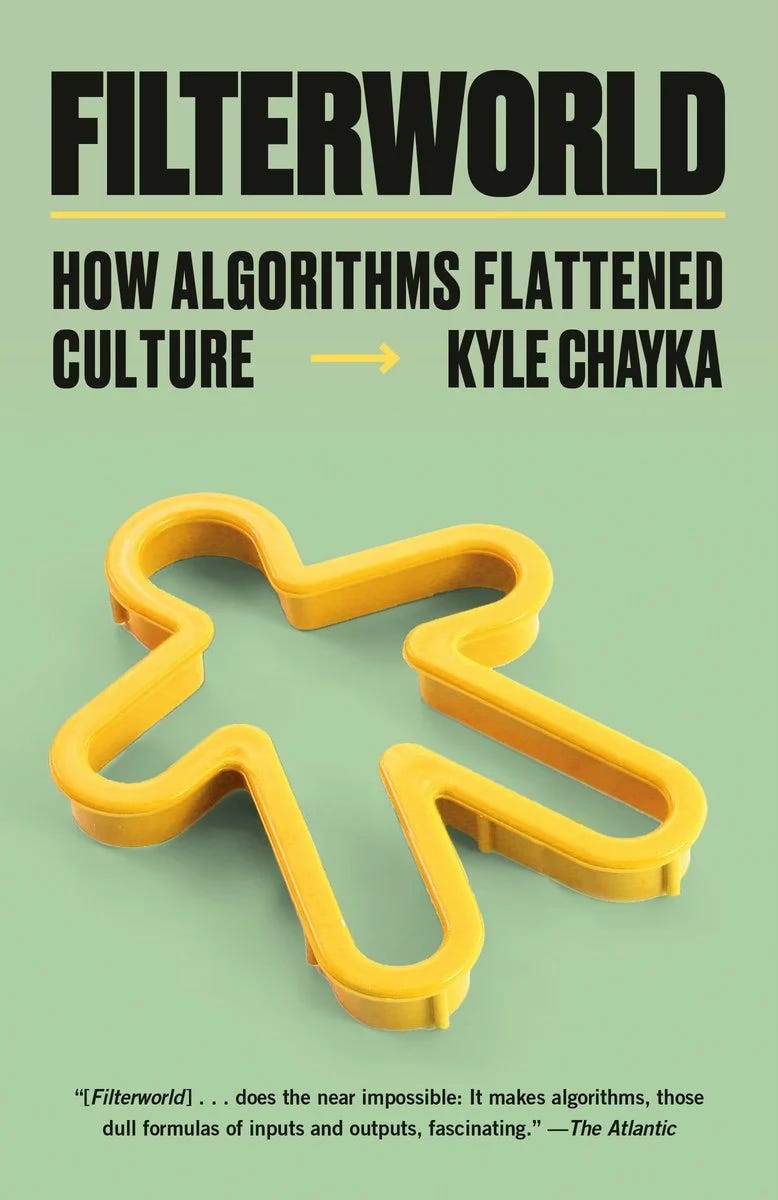
Said bros seem to be recognizing that judgment and discernment may be necessary to sort the genuinely interesting wheat from the AI-slop chaff. Part of the challenge is bound up with Chayka’s argument in Filterworld that the algorithmic sorting of content that is then disseminated globally over social media has resulted in a general inability to know what’s good or interesting beyond what everyone is is paying attention to or doing elsewhere, or really, everywhere. Defaulting to someone else’s judgment means you never have the chance to commune with your own taste.
Using Chayka’s book as a jumping off point I write extensively about taste in More Than Words, emphasizing that the key to having taste is making sure your taste is yours. In the book I admit to being a fan of the band Phish, a condition which many would mark as a sign of me having “bad” taste in music, but the more meaningful aspect of taste is at some level (and that could be a gut level) being able to articulate why you like something.
Not why it’s “good” in general, but why you think it’s good. Once you understand why something is good you can absolutely go on and explain why others should share your taste, but that process always starts with you.
The only way to develop taste is through experience, to practice rendering judgment free of outside interference at the moment of judgment, while also making sure you’ve had sufficient experience to trust your judgment.
I’ve had a lot of practice.
How to Develop Your Taste: Experience

I started editing the McSweeney’s website, by accident, somewhere in June/July 2003.
My friend Dave Eggers called me (maybe he emailed, but I think it was a call) and said they “needed some help” with the website, and would I be open to doing it? We didn’t discuss the nature of the work beyond the desire to put stuff up that would entertain the readership, nor how long I would do it, or anything like that.
I was teaching at Virginia Tech at the time while my wife was in the midst of her residency in small animal internal medicine. The internet was not “new” obviously, but it was much smaller and there were only a handful of publications that seemed worth reading. The McSweeney’s website had published lots of short humorous things, but by no means exclusively published short humorous things. Its publication schedule was also somewhat irregular, reflecting when someone had spare time to think about getting something on the website. I made two executive decisions: I wanted to publish at least one featured humor piece per day along with two “subfeatures,” and I would reply to every submission within one week’s time.
Early on, the harder challenge was finding pieces I thought worthy of running. Submissions would come in, but without a strict editorial focus, they were all over the place and there wasn’t always a huge supply of contenders. I solicited material from frequent, reliable contributors and also hit up my friend Kevin Guilfoile to do a kind of Bizzarro Will Shortz impression through his alter ego, Carlton Doby, giving birth the McSweeney’s Brain Exploder puzzle feature, one of my favorite things we ever did and something I wish I could’ve incentivized Kevin to keep doing.
I also created some subfeature categories from pre-existing material (Lists and Open Letters to People or Entities Who Are Unlikely to Respond) to encourage more submissions in that vein, and invented “Reviews of New Food” writing the first two installments (Plum and Uh-Oh Oreos), myself. I wouldn’t have said this consciously at the time, but in hindsight I was trying to signal as clearly as possible, this is our (my) taste. We want pieces in these formats that do this stuff and achieve these ends.
I had a funny sestina by a friend of mine that I wanted to publish, but we had a policy of not publishing poetry so I said we’d publish poetry, but only sestinas. At some point a guy named Daniel Nester submitted one that I rejected with some rationale that outed me as not having a particularly strong grasp of the form (or really a well-grounded sense of taste), and he sent me a rather intemperate reply calling out my ignorance, so I made him the official assistant editor for sestinas with my only provision that he couldn’t publish himself. Daniel took that bull by the horns and selected dozens (hundreds?) of sestinas for the site over the next four or so years, and later editing The Incredible Sestina Anthology, which is absolutely true to its title.
Fairly quickly that signaling of what McSweeney’s online published led to a significant increase in the number of submissions. The audience and potential contributors had a clearer idea of what we were looking for. When I say “we,” I mean me since I was the only person reading those main feature submissions.
I’d be writing an publishing short humor for a few years at that point, but prior to this moment I had no real editorial experience. All I had was my taste, taste developed by trying to write funny stuff of my own, by collaborating with others to write funny stuff, and by reading funny stuff, going back to puzzling through the New Yorker Shouts & Murmurs selections when I was too young to get the cultural references of the Shouts & Murmurs selections. I was not a humor or comedy nerd, per se, but I knew what I thought was funny, so when I would read a submission, I would simply decide if it was funny. If yes…acceptance. If no…polite rejection.
I was evaluating hundreds of pieces a week and trying to do so as quickly as possible as I was teaching full time and working on my own writing, including my next book. The decisions were clear, fast, and correct because I held true to my guide of listening to my own reaction, my taste. I wasn’t asking if a piece was “good” I was paying attention to whether or not I thought it was funny.
Were my decisions beyond reproach? Of course not. I’m sure I whiffed on stuff I maybe should have published. I’d sometimes see these pieces in other online publications that had cropped up and wonder why I hadn’t jumped on it. Sometimes I would reject a piece and the submitter would reply about what an idiot I was for rejecting them and they didn’t think the site was at all funny anyway.
I never responding to these, but if I had I would’ve asked, why are you submitting to a publication you think is bad, that you think doesn’t have good taste?
Of course, I knew why. We were getting a reputation for carrying some measure of prestige, so the credit of publication in McSweeney’s online meant something in a kind of quasi-marketplace. This is where taste can get fraught and you start to wonder about your reputation, the perception others have of what you do, but I never could figure out how to add those factors into my taste, so I ignored it as much as I possible.
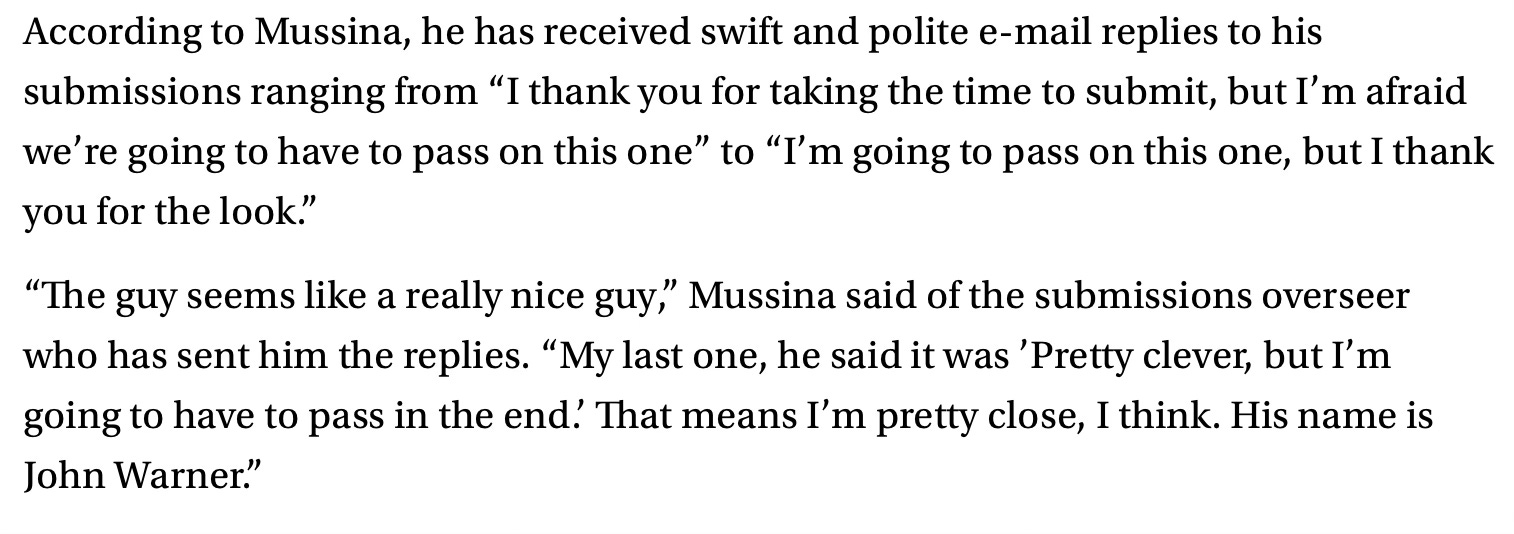
I was diligent, consistent, and the audience for the site and the overall quality of the work grew. I reached my personal pinnacle when I was tweaked in an article in The Onion, “McSweeney’s Reject’s Mike Mussina’s Ninth Consecutive Submission.”
At the time, Mike Mussina was a star pitcher for the Yankees. Whomever wrote the piece had submitted enough to see how I mixed and matched phrases to keep things personal, but also speedy.
It didn’t take all that long for my taste to be almost automatic and I could sense within a few sentences if a piece had a chance. The biggest danger I had to guard against was going into autopilot and not paying sufficient attention to fully engage my taste sensors.
Eventually, the supply became so great I had to outsource the selection of the lists to my friend and frequent site contributor, Ben “B.R.” Cohen, and I can tell you at times it was a struggle because I’d pledged to give authority over to someone else’s taste. Ben and I had very similar sensibilities - that’s why I asked him to do it - but our overlap was not 100%, but the deal, particularly as the work was unpaid, was total autonomy.
What Went Wrong With That Story Everyone Is Talking About
If I had to guess what went wrong in the case of the Granta contest story, it’s that the judge/evaluator had too many submissions to make sure their full taste sensors were engaged and instead fell back on a more general sense of the aesthetics for creative writing that wins these kinds of competitions. Or, they wanted to choose a story that other people would find impressive.
At a glance, it seems like the kind of story that should win, but if you actually dig in and parse what the story appears to be saying, there’s no there, there.
(Something similar sometimes happens in politics where candidates are judged against prior models, rather than being allowed to make their cases for themselves.)
I reached out to my successor as McSweeney’s website editor, Chris Monks, who has done the job longer and better than I ever did, to ask him what he thought about this stuff and whether or not he worried about a fully AI-written piece winding up on the site, and he had an interesting observation that I think is telling when it comes to how people think about taste.
FWIW, many of the blah submissions suffer from being overly manufactured, with too much setup and exposition, etc. Like 15%-20% of subs are from folks who clearly trying to write what they think a McSweeney’s piece is as, and it just feels forced. They’re sort of A.I. themselves, if that makes sense, and it comes off overdone and/or inauthentic.
It’s similar to what happens when students write to a rubric and create a kind of simulation of a school essay. Just because it’s straightforward to categorize the elements of a McSweeney’s-style piece, that doesn’t mean that doing each of these things individually results in something funny.
A funny piece always starts from some spark of inspiration that is then shaped into the proper form. If you read enough attempts, your ability to discern the authentic from the overdone becomes very honed indeed.
Maintaining that level of acuity takes some work and one of the reasons I decided to hand over the reins to someone else was because too much of my brain was wired toward the task of deciding what was appropriately funny for the McSweeney’s website to allow me to do the writing I was interested in. I’m sure I could get those muscles back in shape (I read what’s on the site all the time and still know what I think is funny), but the selecting and sorting Chris Monks is doing is a real expertise.
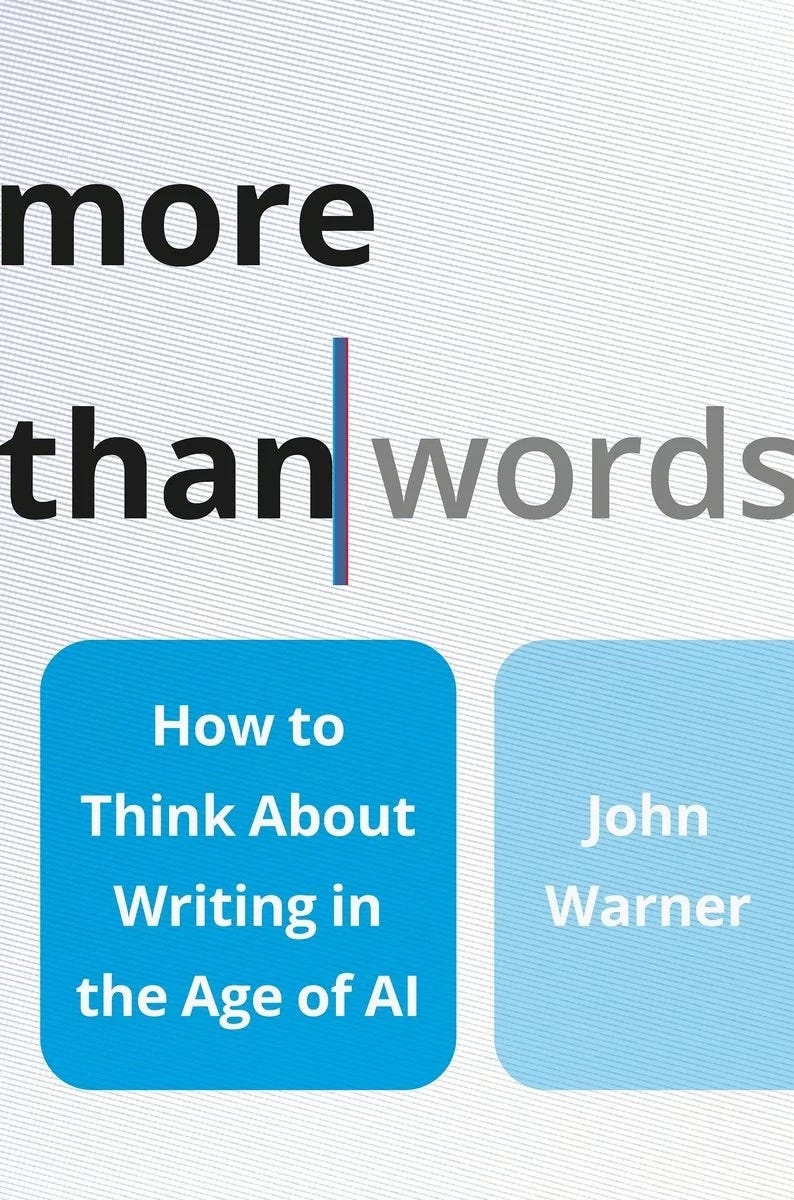
In More Than Words I identified “taste” as one of the most important capacities for humans going forward, given that it was an obvious point of difference between humans and large language models. An LLM does not know what is or isn’t funny.
The fact that aesthetic/emotional response - the root of my response to what I read - is beyond the capabilities of generative AI is one of the reasons I cannot get on board with the idea that they have anything useful to say about a piece of human authored writing.
It’s a shame that the judges of the Granta prize either didn’t have the time to engage their taste or didn’t trust their taste, but this incident does not tell us anything about what AI can or cannot do. An AI story might have been “prizewinning,” but it was not “prize worthy” and the fact that it was awarded a prize is a 100% human failure.
Links
This week at the Chicago Tribune I reviewed Alex Pugsley’s Silver Lake a Hollywood novel with heart and bite.
At Inside Higher Ed I explored degree of molecule rearrangement as a way to measure the “ROI” of a college degree.
At Academic Freedom on the Line I discussed why policies of viewpoint diversity and institutional neutrality don’t help faculty and students be more free.
Paul Bloom explores why Moneyballing book publishing probably wouldn’t work. I agree.
At the New Yorker, Jessica Winter goes digging into the record on Belle Burden’s (Strangers) post divorce finances and discovers what I thought we all assumed, that she was never in genuine financial insecurity.
Via my friends McSweeney's, “I’ll Take This Costco Sample, But Only So I Can Make an Informed Decision” by Tyler Gooch.
Recommendations
1. On the Calculation of Volume II by Solvej Balle
2. Sea and Sardinia by D.H. Lawrence
3. Winter in Sokcho by Elisa Dusapin
4. Transcription by Ben Lerner
5. Watermark: An Essay on Venice by Joseph Brodsky
Ken C. - Wells, ME
On the surface, Halle Butler’s Banal Nightmare seems to want to challenge you to find a reason to care for the characters, but this challenge gives way to a deep consideration of the way the world and our selves can thwart our desires.
ICYMI, I had a Q&A with Alexandra Andrews on her new novel, The Fine Art of Lying.
The Fine Art of Lying with Alexandra Andrews

For years, I would get a reader request for a recommendation and think that I would love to recommend Alexandra Andrews’ Who Is Maud Dixon? but then realize not enough time had passed since the last time I’d recommended it.
I’ve been on the ball, so I’ll have a another Q&A this coming Tuesday with Naomi Kanakia, author of What’s So Great About the Great Books?.
See you next time,
JW
The Biblioracle
Terrific piece, John. Every week, you give us a glimpse of your unique human intelligence. Thank you for that and for your clarity and for your taste.
I was reminded of a passage in Jeanette Winterson's extraordinary essay, "Art Objects":
“Years ago, when I was living very briefly with a stockbroker who had a good cellar, I asked him how I could learn about wine.
‘Drink it’ he said.
It is true. The only way to develop a palate is to develop a palate.”
It takes time and patience and trust and a refusal to believe in the algorithm.
I was truly grateful for this sentence: "It’s similar to what happens when students write to a rubric and create a kind of simulation of a school essay." As a writing teacher, I have never given students a rubric. I have railed against rubrics as something designed to homogenize writing, something made to make grading faster and easier and less human to human.
In 1982, wen I was 11, my 6th grade best friend and I discovered a book called _How to Be Funny: An Extremely Silly Guidebook_, by Jovial Bob Stine (R.L. Stine). It was a spoof on self-help books, but marketed to kids. As budding humor writers ourselves, we found it hilarious.
In response, we co-wrote a play, spoofing the book, and somehow convinced our sixth grade teacher to allow us to turn it into the Great 6th Grade School Play, with the two of us as directors, of course.
We assigned roles, scheduled rehearsals, ran run-throughs, and eventually cancelled the entire thing before the first performance. Our classmates simply did not know how to be funny. They couldn't deliver the lines to our satisfaction. We had taste.
The two of us are still friends today, both of us still writing. We credit our experience as failed 6th grade playwrights as formative in our careers--and our friendship.