
How Humans Work (Or Sometimes Don't)
Thoughts on a visit to Hamilton College.

This past week I made one of my campus visits to Hamilton College in Clinton, New York.
Lots of interesting things happened there, interesting things happen on all my visits because these are genuinely interesting places filled with interesting people, but there is one moment that’s particularly sticking with me, a moment that makes me hopeful we’ll be able to navigate the thicket of uncertainty that currently pervades higher education.
It was a few minutes before I was scheduled to do a talk in the Hamilton “Events Barn,” four or five rows of folding chairs arrayed in front of me, a screen with my title slide behind me.
It’d titled the talk “Only Humans Write: Why You Shouldn’t Outsource Your Humanity to ChatGPT.” It would be an evening of preaching to the choir, but where’s the harm in that? Sometimes the choir needs reminding that they are indeed righteous. Hamilton is a high agency, high touch place, famous for its open curriculum that allows undergraduates to range freely through subjects. It was the locus investigation for what I consider to be one of the most important books examining the potential and impact of post-secondary education, How College Works by Daniel Chambliss and Christopher Takacs.
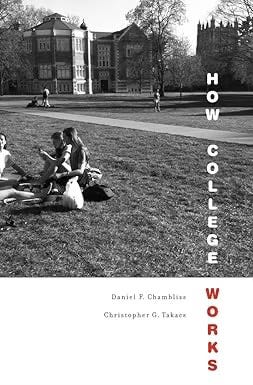
Based on years of observation and interviews with Hamilton students, the book was published in 2014 and when I reviewed it at Inside Higher Ed it was like everything I’d been experiencing as an instructor for the previous decade-plus had been validated.
I underlined so much of the book, that more sentences were marked than not. These were just some of them:
“Good colleges have always been fundamentally human institutions.”
“The fundamental problem of higher education is no longer the availability of content, but rather the availability of motivation.”
“Human contact, especially face to face, seems to have an unusual influence on what students choose to do, on the directions their careers take, and on their experience of college. It has leverage, producing positive results far beyond the effort put into it.”
So I was discretely pacing at the front of the events barn and I see a young gentleman, one of the students, reading and underlining passages in a book with a cover I recognize, David Foster Wallace’s final story collection, Oblivion.
I ask if he’s enjoying it and he says “yes” and I ask if he’s reading it for class and he says “yes,” that it’s for a philosophy of David Foster Wallace course and I ask another kid sitting next to the first kid if he’s in the class too and he says no, but he took it last year, and I said that it’s cool that they offer a course like that every year, and the first kid says that he’d gone to the professor and asked if they could offer it again because he wanted to take it before he graduated and the professor said, “yes.”
All hail the open curriculum where the course sequence and distribution requirements are not set by administrators years in advance and a professor can just decide to teach a course because there are students who want to take it. I cannot overstate how rare this is.
So I’m talking to this first kid, and the other kid, and of course I realize these are not kids, they are college seniors, but give me a break, when you have gotten as old as I am they are “kids,” and I told them about how my freshman year of college at the University of Illinois, my mom, who owned a bookstore, sent me an advance copy of David Foster Wallace’s first story collection, Girl With Curious Hair, because the publisher’s sales rep said it was what the young people were reading these days.
I read it alone in my dorm room over Labor Day weekend when everyone else went home. No one told me that you were supposed to go home Labor Day weekend when school had just started like a week earlier.
That was more than thirty-five years before I was chatting with these two Wallace readers. I read Girl With Curious Hair alone, but these guys had done it as part of a group, the guy reading the book drawn to it by his buddy who said something like, I’m taking this cool class etc…
Another quote from How College Works for no particular reason:
“Isolated from the people who carry them out, programs, practices and pedagogies seem to have little impact. What matters instead is who meets whom and when. Programs succeed only when they bring the right people together. If the right people are involved, a variety of curricula can serve colleges well. If they aren’t, no curriculum will work.”
I delivered my talk, extolling the virtues of human exchange as a defense against self-obviation through automation. The choir sang their hallelujahs, I took some questions, and the young Wallace reader came to talk more as I packed up my materials. He told me his name (which I’ve obviously, sadly forgotten), and we shook hands and chatted for a bit more and before we parted, he recommended a book to me, Technology and the Character of Contemporary Life: A Philosophical Inquiry by Albert Borgmann, first published 2009.
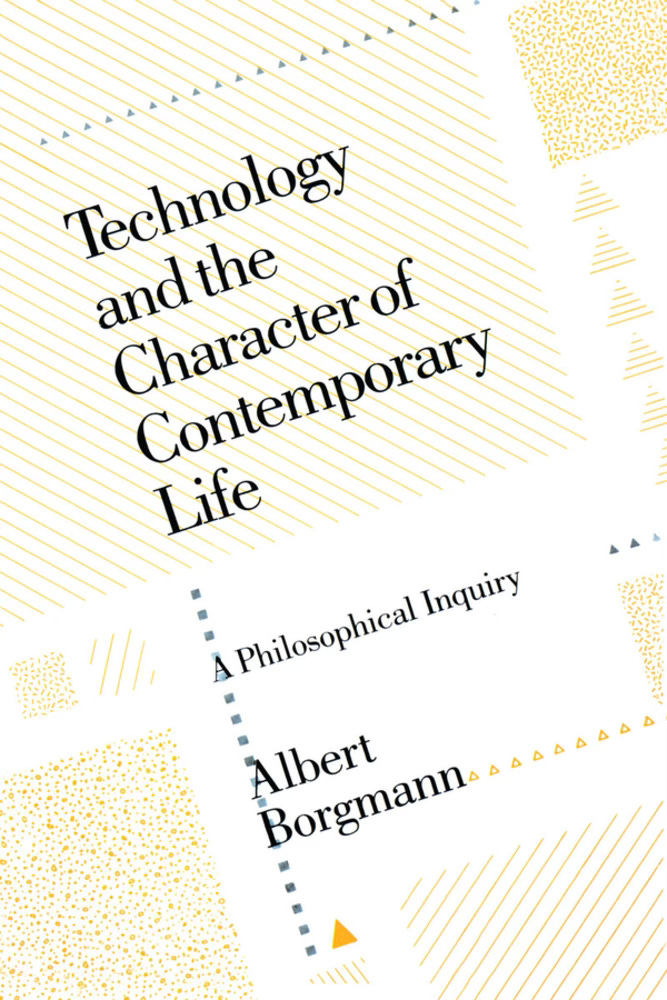
I am now going to quote the book’s description at length:
Blending social analysis and philosophy, Albert Borgmann maintains that technology creates a controlling pattern in our lives. This pattern, discernible even in such an inconspicuous action as switching on a stereo, has global effects: it sharply divides life into labor and leisure, it sustains the industrial democracies, and it fosters the view that the earth itself is a technological device. He argues that technology has served us as well in conquering hunger and disease, but that when we turn to it for richer experiences, it leads instead to a life dominated by effortless and thoughtless consumption. Borgmann does not reject technology but calls for public conversation about the nature of the good life. He counsels us to make room in a technological age for matters of ultimate concern—things and practices that engage us in their own right.
To paraphrase a different sort of philosopher, it had me “public conversation about the nature of the good life.”
So, I’m thinking that yeah, the kids are alright, as are the adults at Hamilton because what we have is a place oriented around being human with resources not unlimited, generally sufficient to supporting humanity. There is a writing lab with 60-some student tutors available to provide help. There are common areas where students can gather and work together. There is an events barn. Whatever challenges AI technology offers, this is the sort of place where people have a fighting challenge to sort through them as best we can.
But before I can get too cozy in these thoughts I recall the opening of my own talk where I shared the landing page of a new genAI-enabled app that had suddenly appeared earlier in the week.
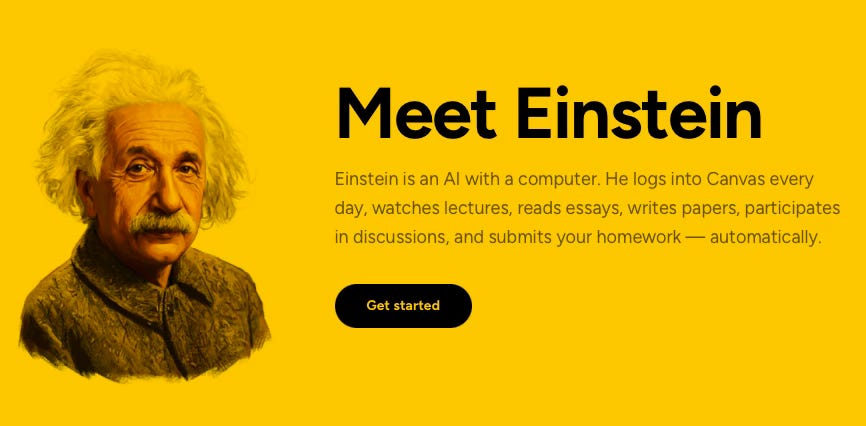
Einstein is the work of Advait Paliwal, a 23-year-old Brown grad school dropout. He claimed in an interview with 404 Media that his goal was to challenge the transactional nature of school, “I think we really need to question what learning even is and whether traditional educational institutions are actually helping or harming us. We're seeing a rise in unemployment across degree holders because of AI, and that makes me question whether this is really what humans are born to do. We've been brainwashed as a society into valuing ourselves by the output of our productive work, and I think humanity is a lot more beautiful than that. Is it really education if we're just memorizing things to perform a task well?”
This sentiment is not so far from what I had to say in my talk, so maybe Advait Paliwal and I are aligned, philosophically, but only one of us was positioning himself to reap investment dollars from venture capitalists for an app that would obviate digitally-mediated education. It’s impossible to say how real Paliwal’s project is, but it has already imploded perhaps because it is vaporware, but also because you can’t just name stuff after Einstein and use his image without running afoul of someone who owns licensing rights.
Is Paliwal morę like the David Foster Wallace reader at Hamilton or Chungin “Roy” Lee, the app developer who engineered his dismissal from Columbia University as a way to launch Cluely, the program that allows you to cheat at everything? Sam Kriss wrote a feature on Lee and a small handful of other Silicon Valley figures for Harpers (“Child’s Play: Tech’s New Generation and the End of Thinking”) that must be read in full to wholly appreciate, but the portrait of Lee as a young person who has amassed millions, but cannot understand why someone would want to read a book is sort of heartbreaking and made me feel ashamed for despising him because his life is self-evidently a misery.
Kriss notes the extreme irony of Lee’s desire for a fully agentic life combined with producing an app that is explicitly designed to make all your decisions for you:
Roy didn’t really seem to have anything in his life except his own sense of agency. Everything was a means to an end, a way of fortifying his ability to do whatever he wanted in the world. But there was a great sucking void where the end ought to be. All he wanted, he’d said, was to hang out with his friends. I believed him. He wanted not to be alone, the way he’d been alone for a year after having his offer of admission rescinded by Harvard. For people to pay attention to him. To exist for other people. But instead of making friends the normal way, he’d walked up to strangers and asked whether they wanted to start a company with him, and then he built the most despised startup in San Francisco. He was probably right: he could count on making a few million dollars every year for the rest of his life, even after Cluely inevitably crashes and burns. He would never want for capital, but this did not seem like the most efficient way to achieve his goals.
It is clear that serially, systemically, Roy Lee did not have the kind of human contact necessary to shape lives that Chambliss and Takac describe in How College Works.
As Kriss says, Roy Lee will “never want for capital” but he seems poorly positioned to become, I don’t know…happy?
I asked the Wallace reader what he was up to at Hamilton. Studying philosophy, with an eye on graduate school someday, but not right away, which I said was sound. He had a knowing look on his face when he said it, like I know everyone says this is a bad idea, but whatever. Au contraire, I think a philosophy grad degree is actually a great defense at whatever indignities the future may have for us. Roy Lee may have the kind of wealth that allows for a certain material security, but his mind appears to be going to waste and it may be our minds are the only things we’re truly allowed to own someday.
This plan makes the Hamilton student a bit of an outlier among his cohort. I was told a significant portion of the Hamilton students will make their way into finance, which is perhaps sensible if you are worried about money or the risk of downward mobility, but also strikes me as a tremendous waste of human potential.
Not quite a Roy Lee-level waste of human potential, but a bit depressing nonetheless, a sign of the very real narrowing of the perceived pathways to continued security in an increasingly hostile world.
Links
At the Chicago Tribune I paid very brief tribute to the passing of Michael Silverblatt, host of Bookworm, an idiosyncratic and great interviewer of authors.
At Inside Higher Ed I wrote some bullet point thoughts on the Einstein app and what it says about where we should be putting our energies in education. At his newsletter, Marc Watkins has a more considered take, dubbing Einstein “nuisance technology,” which is spot-on.
One of the things I occasionally lament about my Tribune column is that I only get 600 words, so I was pleased to read Alexander Sorondo’s much longer, in-depth, reported/reflective piece on Michael Silverblatt.
Mark Oppenheimer, author of an imminently forthcoming biography of Judy Blume was victimized by Kitty Kelly (of all people) with what appears to be an obviously AI-generated review of his book.
Ross Barkan offers a defense of reading (and writing) fiction as a defense against anti-humanism.
Via reader Sean W. an article on “Books and Screens,” “Your inability to focus isn’t a failing. It’s a design problem, and the answer isn’t getting rid of our screen time.”
Via my friends McSweeney's, “Welcome to Books, For Men™” by Tom Ellison.
Recommendations
1. Queen of Dirt Island by Donal Ryan
2. Annie Bot by Sierra Greer
3. Oxford Soju Club by Jinwoo Park
4. Wandering Stars by Tommy Orange
5. The Unfinished Harauld Hughes by Richard Ayoade
Lisa G. - Utica NY
A fascinating list from Lisa who is, not entirely coincidentally, with Hamilton College. I don’t know why this particular book is calling to me base on the list other than it’s one I like to recommend to people who read widely because they usually haven’t read it, A Different Drummer by William Melvin Kelley.
Somehow I woke up the morning I write this newsletter and the maniac in the Oval Office has started a war. It seems clear nothing is real to him that maybe he shares with Roy Lee an insatiable need to exert his agency, only on a vastly more destructive scale. What to do? I really have no idea beyond trying to pay attention to what makes the most sense to me.
See you next week.
JW
The Biblioracle
Great post as always -- I feel like there are more pockets of little Hamilton-ness than we realize. I teach at an underfunded community college with students who work long hours and are in the cross hairs of this regime and yet anytime I get in front of a classroom something great happens. my secret is I don't have to pitch a special class - just teach intro to lit or whatever and then do what you want and usually the powers that be are too "busy" to notice. Here's another piece on Silverblatt I found really moving: https://www.nplusonemag.com/online-only/online-only/youve-done-it-again-michael/
What a wonderful piece, John. Particularly impressed and hope-filled to hear the student recommend Borgmann to you. Borgmann’s device paradigm and the idea of focal practices is an excellent diagnosis of our modern moment, and of education specifically. We try to extract and isolate a particular end of education, and optimize for that end without more efficient means. When we do that we often lose more than we realize. Borgmann uses the analogy of central heating with a furnace compared to a hearth. The warm house might be the same, but these two are not even close to equivalent.
Anyway, I hope you spend some more time with Borgmann. I think you’ll enjoy him. I wrote a bit about some of my reflections on him here a while back. https://joshbrake.substack.com/p/degenerative-ai