
Award/Reward
Does anyone get trophies anymore?

I was thinking recently that I might like to win an award for More Than Words.
I think the chances of that are vanishingly small for a number of reasons. One is that the odds are low for every book published. For example, as unpredictable as the Pulitzer Prize for fiction has been over the years, I would’ve put very reasonable odds on Percival Everett’s James winning (which it did), but reporting after the fact revealed that the only reason it won was because the prize board was deadlocked on the first three finalists that had been submitted and James was added as a fourth option.
It’s also not a book that really fits into any common award categories. It’s not a biography, history, memoir, or a work of reportage. It wouldn’t be appropriate for any awards for academic books. It’s just a book, like most books.
I think I might want an award because I want a trophy.
Maybe I’ve been thinking about this because on my recent trip to Chicago my sister-in-law was gracious enough to lend me her home office for a morning and I looked over at one of her bookshelves and admired all of her “deal trophies.” She’s retired now, but my sister-in-law was a high placed lawyer at a couple of very large corporations with responsibilities for negotiating and executing major transactions, and apparently as part of these processes, when the deal is over, certain folks who were involved get a memento in the form of a special commemorative object that I’m just going to call a trophy.
My sister-in-law is a practical type, so she’s only kept a fraction of those she received over the course of her career, mostly the ones that look cool on a shelf in a home office, and they do look cool, so cool that some lizard part of my brain said, I want one.
Maybe this is an atavistic desire from my childhood, which was largely a trophy-free (also no ribbons or medals) experience. I was a team sports kid and to get a trophy you usually had to win the whole enchilada and my teams never won the whole enchilada. My older brother was a swimmer, and swimmers seemed to get a ribbon or trophy for jumping into the pool. (I recall sixth place got a pink ribbon.) He was a good swimmer so most of his ribbons were blue (first), red (second), or white (third). As I recall, he didn’t seem to care about them much. They were not his motive for competing as a swimmer.
Winning an award and getting a trophy for it is obviously not a sound motive for writing a book, and it’s not why I wrote this book, so I’m a little confused as to why this urge has appeared.
Maybe it’s part of an unrequited quest to get a trophy for an award I was part of when I was editing McSweeney’s Internet Tendency. In 2007 (I think) we won a Webby Award for best humor website. (As I recall, we beat The Onion.) This is the trophy:
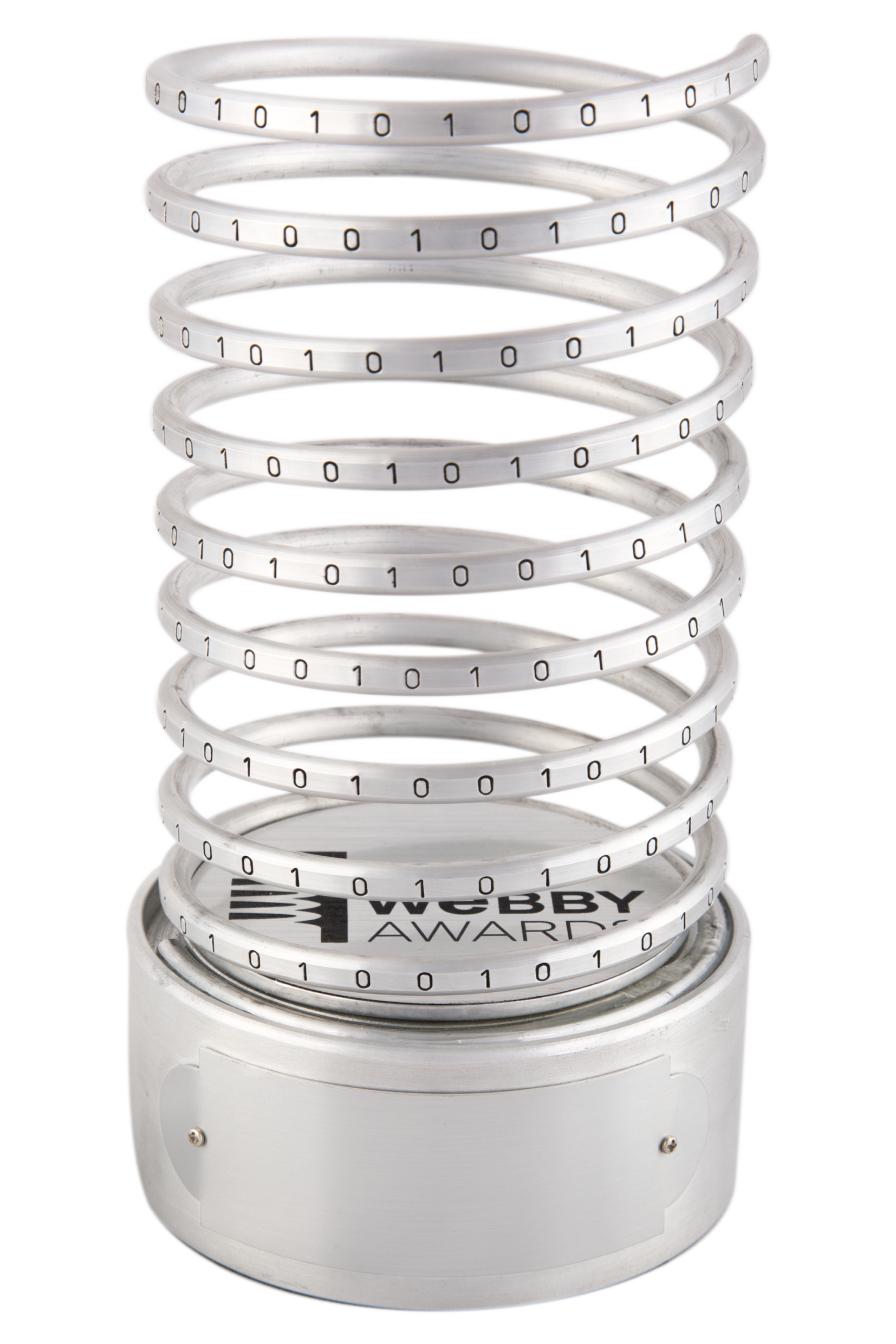
I don’t think anyone from the organization went to the actual awards banquet, and I guess the trophy itself was shipped to headquarters in San Francisco. After we won, I got it in my mind that I’d like a trophy - I’d earned it! - and maybe I should also get one for my assistant editor as a gesture of thanks.
When I queried the Webby Awards organization about possibly getting additional trophies I was told this was entirely possible and they’d be happy to do so for something like $250 a piece. (It might’ve even been more.)
End of pursuit of that trophy. I also found out it was costing us like $500 a year to enter the awards, a cost that I could not justify given that at the time we generated zero revenue, so I asked for us to stop putting in for the awards.
(This structure is not unique. It costs $75 put a book up for the Pulitzer. Even the Grammys and Oscars have nomination fees, though nothing like the Webbys).
By happenstance I’ve laid eyes on a couple of major awards far more impressive than a Webby in the wild. My graduate writing professor Robert Olen Butler had a crystal the Pulitzers give you on a table in his house commemorating his 1993 award. A childhood friend’s father won the Heisman Trophy, and I once glimpsed it in a room on the way to the bathroom.
Maybe I want to win an award because everyone wants a little uncomplicated, unqualified recognition that you did a good job, and the trophy there on the shelf is a nice reminder of that fact. Reviews and reader feedback can be nice recognition of what you’ve done, but these are rarely uncomplicated. I am experiencing this first hand during the Perusall Exchange event for More Than Words which has a few hundred people simultaneously reading and commenting on the book. On the one hand, it’s very rewarding to be taken seriously by so many smart and informed people.
On the other hand, it’s a little anxiety-making to be taken seriously by so many smart and informed people. There is an element of simultaneously being feted and roasted. I’m assuming when you win an award and you go to the nice banquet and are handed the trophy and give your speech thanking everyone you get at least a moment of peace that you’ve done a good job.
Or maybe not. One of the most famous and oft-ridiculed Oscar speeches of all-time is Sally Field’s “You like me, you really like me!” when she won her second Academy Award for Places in the Heart after a previous win for Norma Rae. Field was mocked as desperate and needy at the moment of her greatest triumph. It’s tough that enthusiasm and joy is turned around this way, particularly given that Field never said the sentence used to make fun of her. If I ever was nominated for an award I can already tell I’d desperately want it, which is uncool to admit, but it was uncool to admit that I want a trophy at the top of the newsletter anyway.
I am tempted to scoff at the time and expense of producing those deal trophies my sister-in-law received, but I’ve seen the extreme amount of work that sealing these deals required, and honestly, a token for the effort seems entirely appropriate.
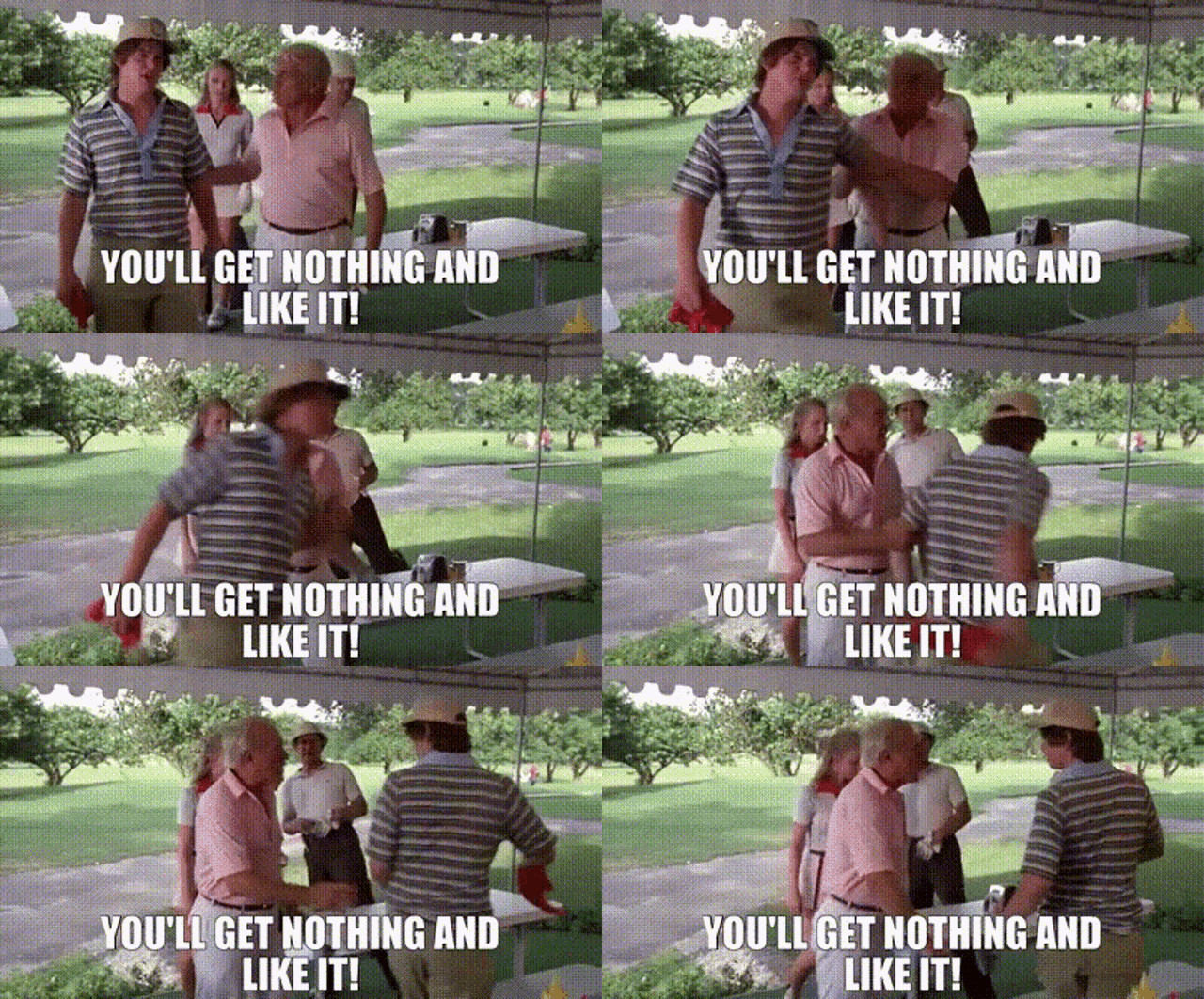
The trophy itself may be meaningless, but what it represents is often not. This was part of the critique of the so-called “everyone gets a trophy” generation, where we substituted symbols for genuine accomplishment. I couldn’t even tell you which generation this is meant to describe anymore (Millennials?), and it all seems sort of moot now that we’re in the era of “You’ll get nothing an like it” for everyone save the tech oligarchs and the politicians they’ve purchased.
Just this morning I finished reading Adam Becker’s amazing new book, More Everything Forever: AI Overlords, Space Empires, and Silicon Valley’s Quest to Control Everything. Reading it has been a simultaneously terrifying and reassuring experience.
On the one hand, it is impossible to overstate how radical the designs are of the world’s richest people, many of whom now have a direct line to the U.S. government. At their most extreme, they have visions of colonizing the entire visible universe, a vision that would be made possible by harvesting (and destroying) every star.
On the other hand, Becker shows in a way how sad and human the roots of these desires are. Some of these very rich men are mostly afraid of dying. To live forever (as some kind of sentient transhuman creature) they are willing to destroy all living things.
Others (primarily Marc Andreessen) believe that tech leaders have not gotten their proper due. Maybe someone should’ve given the man a trophy (or maybe a hug?) sometime.
So, no trophies for me, but I still would like one of those cakes with my book’s cover embossed on it in the frosting.
I’ll be looking into that.
—
Who among readers has won an award and received a trophy? How did it feel?
Links
Because I slacked off and didn’t post any links last week I have to catch up with my Tribune columns. Last week I reviewed the haunting new novel The Passenger Seat by Vijay Khurana. If anyone says they don’t publish novels about young men anymore, check it out. This week I shared my appreciation for the work of Erik Baker in his new history, Make Your Own Job: How the Entrepreneurial Work Ethic Exhausted America.
A bunch of journalists and writers shared how they’re using AI at the Columbia Journalism Review. I share this as a buyer beware for work of some of these folks, or one person working on a book about running in particular.
“Is the next great American novel being published on Substack?” asks Peter C. Baker himself a proprietor of an interesting music newsletter Tracks on Tracks, and featuring the work of one of the newsletters I read every week by Naomi Kanakia.
Highly recommend this Ezra Klein Show podcast interview with Rebecca Winthrop, co-author (with Jenny Anderson) of The Disengaged Teen: Helping Kids Learn Better, Live Better, Feel Better.
Via my friends McSweeney's who deserve all the Webbys, “To the Dad Coaching Third Base, Wearing a ‘Women Want Me, Fish Fear Me’ Hat” by Tyler Gooch.
Recommendations
1. Lady Joker by Kaora Takamura
2. The Years by Annie Ernaux
3. Drive Your Plow Over the Bones of the Dead by Olga Tokakrczuk
4. Crime and Punishment by Fyodor Dostoyevsky
5. Ways of Being by James Bridle
Ruth C. - “The south coast of England where the chalk cliffs of France are often in view from my window as I read.”
Could be me favorite reader location ever. For Ruth I’m recommending the sui generis work of Helen DeWitt, The Last Samurai.
1. Prophets and Idiots by Jonas Jonasson
2. Elantris by Brandon Anderson
3. The Ministry for the Future by Kim Stanley Robinson
4. Focussing by Eugine Gendlin
5. Three Body Problem by Cixin Liu
Liesbeth M. - Rotterdam, Netherlands
For Liesbeth I’m recommending Babel: Or the Necessity of Violence (An Arcane History of the Oxford Translators Revolution by R.F. Kuang.
Alrighty gang, another week in the books. I’m looking forward to my first week in a while where I am at home for the entire time. It’s a privilege to be able to travel to and fro to talk about things that are meaningful to me, but also it’s nice to be home.
If you’re in the Charleston, South Carolina area, I’ll be doing a brief public talk at the Unitarian Church Sunday forum on May 25th at 10am prior to the weekly service. Details are here.
Take care,
John
Humorously related: I had a student ask once if she could an A because she really wanted an A. I then asked if she wanted to submit work. Crickets.
About 10 years ago I was recognized as teacher of the year by my district. Along with other teachers in the area, we were celebrated before an Angels baseball game and again at a dinner hosted by the Disneyland hotel where we received a cash gift and a Disney-themed pin, more of a medal than a trophy. It was a great experience as teachers do not receive many, if any, accolades, and it was even more meaningful because I was nominated for the award, rather than having to apply and pay for the chance at recognition.
But that experience pales in comparison to the feeling of accomplishment and pride I’ve felt recently as one of my former students has just published a book, “Hopes for School: A Student’s Experience and Ideas for Educational Transformation”
— a book that began as an assignment in my class. She invited me to write the forward, which in itself was an honor. This book is far more meaningful to me than a trophy or pin, or being paraded around the diamond and being fed a Disney dinner.