

Occasionally, in my public talks I will talk a little mild shit about Ethan Mollick.
Mollick is a professor at the Wharton School of Business, the author of 2024’s Co-Intelligence: Living Working with AI, and Co-Existence: The Next Phase of AI, which was released this past Tuesday.
I call Professor Mollick the “AI whisperer for the consultant class” because it’s kind of funny, the groups I’m talking to (mostly educators) understand what I’m signaling with that choice of language, and also it’s true.
I also say that I consistently and with interest read most, if not all, of Ethan Mollick’s public writing. I name him as one of my chief AI “guides” towards the end of More than Words. His description of AI-writing as “meaning shaped attention-vampires” is so spot on that I quote it with frequency, and while I haven’t asked him directly, I’m betting he might significantly agree with me that the worst possible use for generative AI is writing.

My “beef” with Ethan Mollick (to the extent I even have one) is that I use a fundamentally different lens in considering living with AI. He is focused on AI as a way to advance business activity, particularly entrepreneurship. Much of his research and public writing is on the increasing apparent capacities of generative AI in this realm, and assumes a kind of desirable inevitability of this human/AI co-work.
He uses something he calls “the otter test” in which he asks an AI image generator to create an image of an “otter on a plane using wifi” in order to track the increasing power of generative AI in the period between his two books, which he now calls “the exponential.” His most recent newsletter declares that “the otter test has fallen,” sharing a funny little meta video about the otter test crated with Claude Opus 5.5.
The video is an undeniably impressive feat of technology, but in my view it tells us nothing about how and when AI may be genuinely useful to humans. It is a perfect example of what I call the “AI novelty cycle”, which I believe actively detracts from being able to have a sensible and meaningful conversation about what role (if any) people should give AI in their lives.
No doubt, I must also admit that some of my irritation is in the fact that the view Ethan Mollick exemplifies (though he’s far more thoughtful than others who also exemplify this view) is absolutely dominant in the discourse, and its dominance is directly harmful to the stuff I’m working on, teaching and writing.
But all that isn’t really Ethan Mollick’s fault, we may both be involved in the same game, but we’re operating on very different parts of the field. He is both an excellent guide and a useful foil for what I hope to accomplish.
And anyway, I come here today not to bury Ethan Mollick, but to praise him.
I have only just started reading Co-Existence: The Next Phase of AI, but based on the marketing materials, I can tell I’m going to like at least something about it.
That said, I do not care for what the title implies, literally centering AI, as though it is our job to co-exist with it, as opposed to the other way around. Mollick’s technological determinism is showing here, and it irritates. A more helpful book about AI for humanity as a whole would be titled Unplug It: The Next Phase of AI.
Let’s also not lose sight that between AI and human beings only one of us truly exists in the I think therefore I am sense, and it isn’t AI.
But I get it. The title is too tempting in light of his original book and the milieu he works within. He’s not the AI whisperer for the consultant class for nothing.
But more interestingly and substantively are his big picture conclusions about what humans must cultivate in order to thrive in this co-existence. It’s been handily called-out in this graphic produced by his publisher.
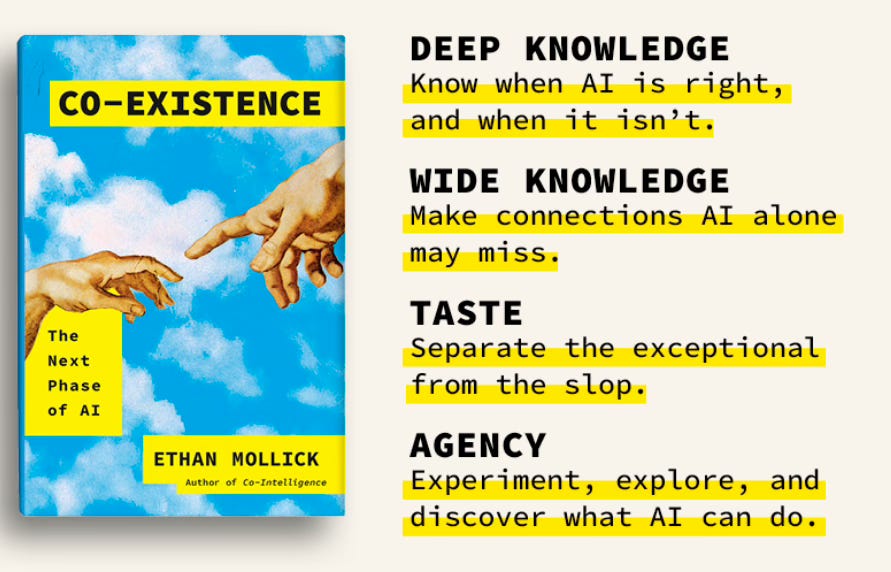
I found this graphic very exciting because these are (among) the things I argue human beings should cultivate in More Than Words: How to Think About Writing in the Age of AI, a book that was first published 20 months ago and will be coming out in a handsome revised paperback edition with additional material this coming Tuesday, October 27th.
I’m not going to sit here and gloat that I got to these conclusions 20 months ahead of Ethan Mollick - Wait, I just did. - but I am going to say that it’s pretty darn interesting that somebody who spends all his time thinking about and working with AI (Ethan Mollick), and someone who spends as little time as possible thinking about AI, and zero time working with it (me) have come to the same conclusion about what’s important for human beings.
And do you know what the best activities for developing these four capacities are?
Reading and writing. Deep knowledge, wide knowledge, taste, agency…all practices that are developed through reading and writing.
What this means for education, particularly early grades, is that we must do much more reading and writing, and not just any reading and writing, reading and writing that helps students build knowledge, taste, agency, and all kinds of other elements of their reading and writing practices. Ethan Mollick is advocating for centering the exact things that are the engine behind the experiences in my book of curriculum, The Writers Practice. This is exciting.
The chief challenge is that our systems of schooling are not necessarily oriented around these values, and introducing AI into these systems has only make things worse. Even worse than that, we’ve lost a lot of time futzing around with AI, assuming that something so apparently powerful must be useful, but Ethan Mollick and I are both here to tell you that it’s not necessarily the case.
Still, this clarity across very different contexts about the challenges and the goals for our human learners is excellent and the kind of thing we can really work from if we just choose to do so.
Links
There comes a time in a reader’s life when he has to look at his fandom of the Reacher novels and TV series and confront the question, Is Jack Reacher a sociopath? That’s my challenge at this week’s Chicago Tribune.
At Academic Freedom on the Line I interviewed Barrett Taylor and Brendan Cantwell about their deeply insightful new book, The Post Liberal University: Governance, Leadership, and Partisanship in Higher Education.
Not really books-related but relevant to the main piece up above, Timothy Burke works through some sensible thoughts on what grades and “grade inflation” does and does not mean.
I haven’t read this piece from Nathan Heller on how “Books Aren’t Going Anywhere,” but I’m eager to, based on the fact that I agree with the title.
Via my friends McSweeney's a piece that hits close to home, “Halloween Costume Ideas for Gen Xers,” by Julie Klausner.
Recommendations
1. “A Visit from the Goon Squad” by Jennifer Egan
2. “Bel Canto” by Ann Patchett
3. “Heavy” by Kiese Laymon
4. “The Sympathizer” by Viet Thanh Nguyen
5. “Plainsong” by Kent Haruf
Dickie T. - Bangkok, Thailand
Possible the award for the most far flung request of all time. My newsletter goes out on Sunday as far as I’m concerned, but I think Dickie is probably getting it on Monday where he is. Anyway…great, interesting list of books. I’m going with Trust Exercise by Susan Choi.
Phew, so much to touch on in these bottom of page announcements that I should probably put at the top so more people see them, but I’m always thinking about the needs of you, the reader, not me, the writer desperate for attention.
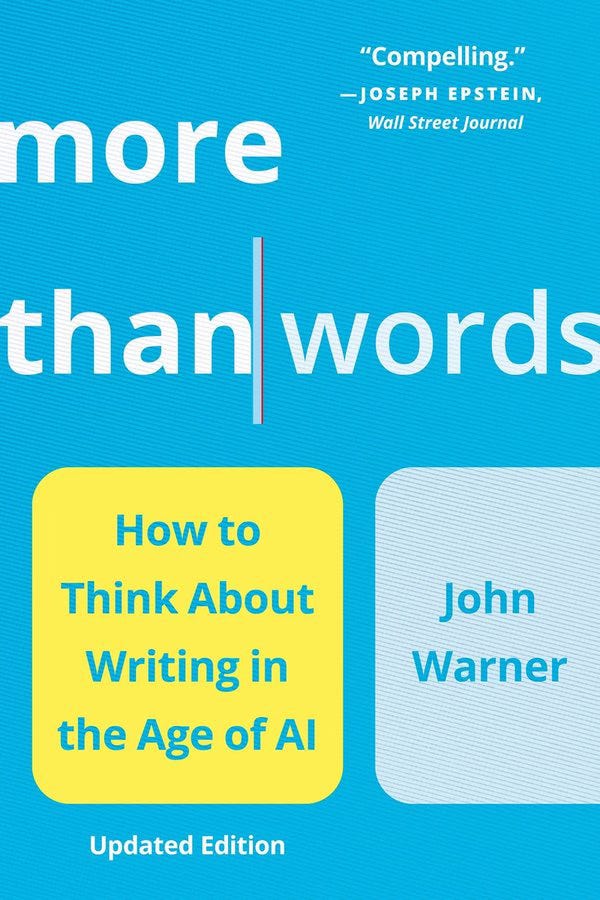
First, as mentioned above, the revised paperback edition of More Than Words is available on Tuesday. It also includes some snazzy new back matter that makes it suitable for all kinds of discussion in and beyond school contexts.
Second, don’t sleep on symposium on Creative Writing in the Age of AI being held at the Mark Twain House and Museum and streamed online on November 7th. It’s really going to be a lot of fun.
Lastly, for now, I’m pleased to say that I’ve gotten the greenligiht to produce a revised edition of The Writer’s Practice where I will be adding and altering some of the writing experiences and producing a new introduction that explicitly frames the book as an alternative to inviting AI into the writing classroom. Very exciting and what I’ll be working on feverishly from mid-November to January 3rd.
Alright folks. Hope everyone’s having a good fall. I, myself, have seen some spectacular foliage.
See you next week,
John Warner
The Biblioracle
Thank you as always for your work, John. A couple of additional thoughts:
- In addition to reading and writing, I would add thoughtful conversation with other human beings.
- Even with the apparent point of contact between your work and Mollick's, I see two critical points of divergence. The first is that where you argue that we should cultivate these capacities for the sake of our humanity, Mollick is arguing that we should cultivate them for the sake of managing AI, implicitly framed as the essential object of our regard. The second has to do with who this work is for. Your answer has been, "for us, as human beings." Mollick's answer implicitly appears to be, "for us, the managerial and entrepreneurial class." Not the same!
- Taking a quick look at Mollick's otter article: (1) why did I inflict that on myself? (2) The thing that strikes me here is not how much the otter may have "improved" but how much Mollick's own writing has deteriorated over approximately the same period. He used to have a bit of a knack for putting a veneer of humility and humanity on LinkedIn think. That veneer has increasingly cracked and peeled away and what's left is essentially this is your brain on drugs, but for AI. My takeaway is that this stuff is really not good for people and to the degree that we care about cultivating our humanity, we should stay the heck away from it.
I appreciate your reflections on how you engage with Mollick’s work. I similarly find his writing at once informative and grating and it’s always been hard to say why (people have asked me and I’ve struggled to respond coherently). I think you’ve helped me clarify this a bit more.
One thing I’ll add is that he just always seems so smitten by the technology, so seemingly eager to get carried away by it. I think it most comes through when I hear him interviewed. As sensible as some of his suggestions may be, he does not convey the sort of slow reflection that is so sorely needed.